IT Consulting Trends for 2026
Composable enterprise, FinOps, platform engineering… Five key topics that will set the agenda for the coming year.
IT Consulting Trends for 2026
Digital transformation is no longer a project; it's a fundamental part of how we do business. However, the pace and direction of this transformation are constantly changing. For 2026 and beyond, IT consulting is evolving beyond simple system installations into a complex partnership role that enables organizations to achieve their strategic goals through technology. Five key trends emerging in this new era are radically changing not only the technology agenda but also how consulting services are delivered and how their value is measured. From composable architectures and FinOps maturity to platform engineering and AI-augmented consulting, these topics provide a roadmap for building the competitive and resilient organizations of the future.
H2: Composable Enterprise: From Monolithic Structures to a Modular Future
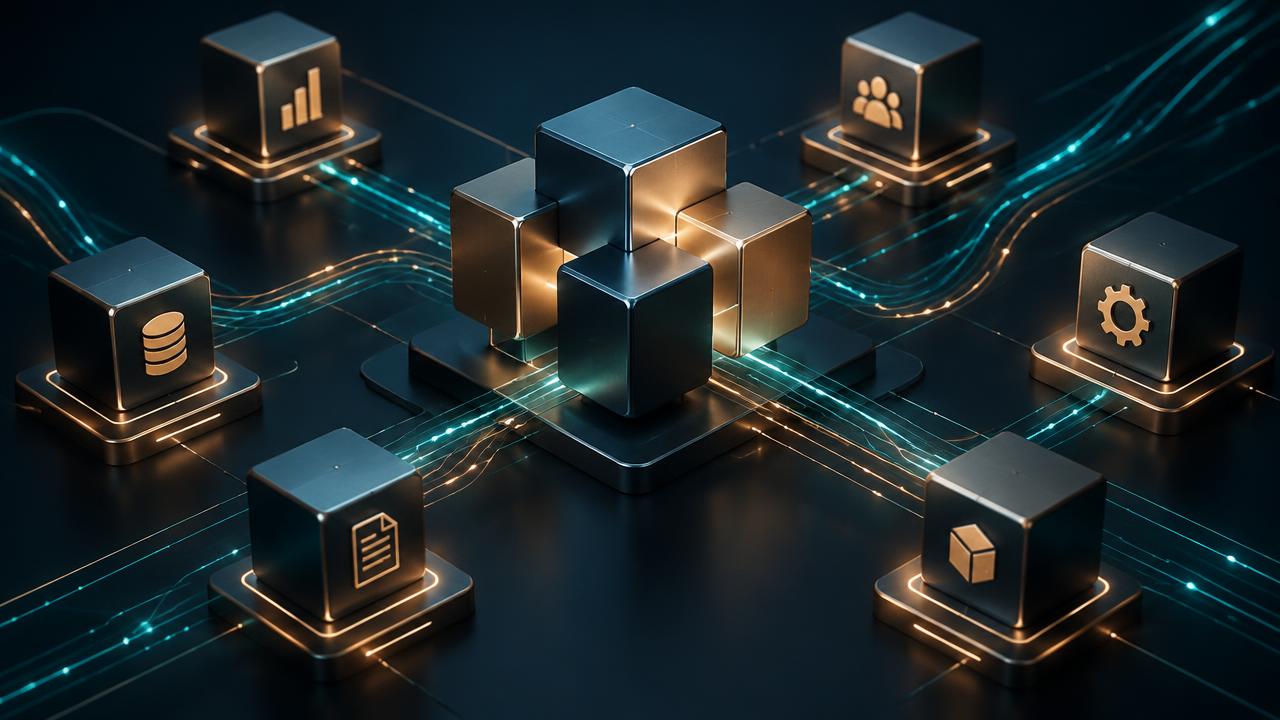
Monolithic ERP systems and custom software, which have been the backbone of organizations for many years, can become shackles in today's rapidly changing market conditions. The fact that every small change request leads to months-long projects, risky "big-bang" updates, and high costs severely limits the agility of business units. The "Composable Enterprise" offers a radical solution to this problem: instead of viewing the entire system as a single massive block, it involves thinking of business capabilities as modular, interoperable, and independently developable units, like Lego bricks.
At the heart of this approach are "Packaged Business Capabilities" (PBCs) and an API-first philosophy. A PBC is a self-contained software component that performs a specific business task, such as "customer information validation," "stock level inquiry," or "invoice creation." These components communicate with each other and the outside world through standard and secure APIs (Application Programming Interfaces). As a result, adding a new e-commerce feature or offering a new service for a mobile app does not require changing the entire ERP system. It is enough to assemble the relevant PBCs or develop a new one. This reduces time-to-market to weeks or even days, providing the organization with a huge competitive advantage.
From a consulting perspective, this trend necessitates a shift from the "we are doing an S/4HANA project" approach to asking, "How can we make our client's supply chain capabilities more flexible?" The consultant's role is no longer just to install a system, but to analyze the client's business processes to identify which capabilities can be packaged as PBCs, design the right API management strategy, integrate different technologies (e.g., both SAP and a cloud-native microservice) to work in harmony, and most importantly, adapt the corporate culture to this modular and agile structure.
H2: FinOps Maturity: From Cloud Spending to Value Creation
The "pay-as-you-go" promise of cloud computing has turned into a "pay without knowing how much you use" reality for many organizations. Cloud bills have become unpredictable and unmanageable due to uncontrolled virtual machines, forgotten storage spaces, and improperly sized services. FinOps is a cultural practice and methodology aimed at disciplining this chaos. However, the goal of FinOps is not just to cut costs, but to make it measurable how much business value each dollar of cloud spending generates.
FinOps maturity is generally considered in three stages: Inform, Optimize, and Operate.
- Inform: The first and most critical step is transparency. Clearly seeing who is spending how much on what. This requires all cloud resources to be correctly tagged according to criteria such as project, department, or product; creating centralized dashboards that show real-time spending; and setting up automatic alarms for budget overruns.
- Optimize: Once visibility is established, savings opportunities are sought. Techniques such as "rightsizing" (resizing services to actual needs), shutting down unused resources, and taking advantage of cheaper committed-use models like "spot instances" or "reserved instances" come into play at this stage.
- Operate: The highest level of maturity is embedding FinOps into the organization's DNA. Development teams see the real-time cloud cost of the code they write and take responsibility for it. Cost optimization becomes part of the software development lifecycle (CI/CD). Budgeting and forecasting become much more accurate based on historical data.
For IT consultants, FinOps has moved beyond simply presenting a cost report. The consultant leads the establishment of a "FinOps Center of Excellence" within the organization, defines tagging standards and governance policies, trains teams on FinOps practices, and most importantly, builds a model that links cloud spending to business KPIs such as revenue, customer satisfaction, or operational efficiency. The question should not be "Why is our cloud bill so high?" but "How much additional revenue did our $200,000 investment in the cloud bring us this month?"
H2: Platform Engineering: Turning Developer Productivity into a Strategic Advantage
The rapid development of digital products and services is essential for staying competitive. However, in many organizations, software developers spend a significant portion of their time not writing code, but solving infrastructure problems, waiting for security approvals, setting up test environments, or dealing with deployment processes. This is both a costly waste of time and a demotivator for developers.
Platform Engineering is a discipline that has emerged to solve this problem. Its main purpose is to create an "Internal Developer Platform" (IDP) that provides all the tools, infrastructure, and processes developers need in a standardized, secure, and self-service manner. This platform offers "golden paths" that abstract away complex infrastructure details for developers. With just a few commands or through a web portal, a developer can have an environment suitable for their project—with pre-configured security and network settings and a ready-to-use test and CI/CD pipeline—in seconds.
The consultant's job is to design this platform as a product. The customers are the organization's own developers. Their most common pain points are identified through surveys and interviews. The platform is developed iteratively to address these bottlenecks. Success is not measured by saying "the platform is installed," but by improvements in "Developer Experience" (DevEx) metrics. For example, KPIs such as the cycle time from an idea to production, the duration of CI/CD processes, or the frequency with which developers encounter infrastructural obstacles are tracked. A well-designed IDP can increase developer productivity by 30-40%, which directly translates into the company's innovation capacity.
H2: AI-Augmented Consulting: A New Dimension in Productivity and Quality
AI won’t put consultants out of a job, but consultants who don’t use AI will struggle to compete. This trend describes how AI is fundamentally transforming consulting processes. Generative AI assistants allow consultants to complete tasks that previously took hours or days in minutes, giving them back their most valuable asset: time. This allows consultants to focus on more strategic, creative, and client-centric work.
Practical applications of AI-augmented consulting include:
- Rapid Analysis and Insight: Analyzing thousands of pages of system logs, financial statements, market research reports, or customer surveys in seconds to provide summaries, identify key themes, anomalies, and potential risks.
- Qualified Content Generation: Automatically generating first drafts of project proposals, presentations, training documents, user stories, test scenarios, and even boilerplate code that conforms to specific standards.
- Problem-Solving and Ideation: Used to generate different solution hypotheses for a problem, question the potential weaknesses of a strategy, or act as a "sparring partner" in a brainstorming session.
In this new equation, the consultant's most important skill becomes the ability to ask the right questions (prompt engineering) and to critically evaluate the output produced by the AI. Refining, verifying, and transforming the raw information provided by AI into actionable strategies tailored to the client's specific context, industry dynamics, and company culture constitutes the indispensable value of the human consultant. The quality of the output is elevated by consultants who can use AI not just as an answer machine, but as an intelligent assistant.
H2: Sustainable IT (Green IT): From Environmental Responsibility to Competitive Advantage
Corporate sustainability, once seen as a "public relations" activity, has now become a financial necessity that yields tangible business results. Regulations like the European Union's Corporate Sustainability Reporting Directive (CSRD) are forcing large companies to report in detail on the environmental impact not only of their own operations but of their entire supply chains (Scope 1, 2, and 3 emissions). This puts IT departments, and therefore IT spending, under scrutiny.
Sustainable IT focuses on three main areas:
- Energy Efficiency: Data centers and servers are massive energy consumers. This involves migrating from inefficient, old on-premise data centers to hyperscale cloud providers that use energy much more efficiently. In the cloud, it means shutting down unnecessary services and reducing CPU consumption through efficient coding practices.
- Hardware Lifecycle: Managing the environmental impact of the entire process from production to disposal of servers, laptops, and other devices. This includes responsible recycling of e-waste and extending hardware lifespan.
- Measurement and Reporting: Accurately measuring the carbon footprint caused by IT operations. This requires calculating the emissions resulting from running ERP systems (like SAP), using cloud services, or developing a piece of software. Tools like the SAP Sustainability Control Tower are beginning to play a central role in this area.
For IT consulting firms, Green IT is a new and rapidly growing service area. The consultant helps the client establish a baseline for their current IT carbon footprint, set science-based reduction targets, create a roadmap to achieve these targets, and build the necessary reporting infrastructure. It is now becoming a standard requirement in many public and large private sector tenders for bidding firms to present their own IT sustainability scorecards.
Practical Implementation Steps: A Checklist
If you're wondering where to start implementing these trends, here is a practical checklist:
- [ ] Composable Enterprise: Identify the slowest and most complained-about business process in your organization. Start a pilot project to redesign the supporting capabilities as a modular service.
- [ ] FinOps: Create and immediately implement a consistent and mandatory "tagging policy" for all your cloud resources. At a minimum, "project," "department," and "owner" tags should be mandatory.
- [ ] Platform Engineering: Ask your development team, "What are the top 3 things that slow you down when starting a new project?" Focus on creating a single "golden path" that solves the biggest problem based on their answers.
- [ ] AI-Augmented Consulting: Provide your consulting team with licensed access to a generative AI tool that protects the confidentiality of corporate data (e.g., Azure OpenAI, Google Cloud Vertex AI). Hold a monthly session where teams share their best prompts and use cases.
- [ ] Sustainable IT: As a first step, have the annual carbon footprint of your most resource-intensive system (usually the ERP) calculated using your cloud provider's tool or with the help of a consultant. This will provide a concrete starting point.
Common Mistakes and Pitfalls
- Mistaking the Trend for Technology: All these topics are more about cultural and operational model changes than technology. You can't become "composable" or "do FinOps" just by buying new software.
- Trying to Take Big Steps: Instead of waiting years for a perfect platform or a fully modular architecture, it is essential to proceed with small, iterative, and value-focused steps.
- Focusing on the Wrong Metrics: Thinking that the sole purpose of FinOps is to reduce the cloud bill or starting Platform Engineering without measuring Developer Experience (DevEx) will cause you to miss the most important benefits of the project.
- Blindly Trusting AI Output: The outputs of generative AI can be unverified and out of context. Copying this output directly into a client document is a major risk to professional reputation.
- The Greenwashing Trap: Using sustainability efforts merely as a marketing slogan without supporting them with measurable data carries both legal risks and damages the organization's credibility.
Conclusion: The Consultant of the Future is a Strategic Orchestrator
The IT consulting trends of 2026 are not isolated technological innovations, but interconnected and complementary strategic approaches. A composable architecture is better managed with FinOps and developed faster by a Platform Engineering team. All these processes can be made more efficient and intelligent with AI-augmented tools. Sustainability is positioned as an umbrella principle that covers all these efforts.
In this picture, the role of the IT consultant is shifting from being an expert in a specific technology product to becoming a strategic orchestrator who brings all these different disciplines together in line with the client's strategic goals. Success will no longer be measured merely by the on-time, on-budget delivery of a system, but by how quickly the organization can adapt to market changes, how innovative it can be, and how resilient it has become. Building the future requires this strategic vision.